
Anthropic API works great — but it's not cheap. And what happens when you're in a region with limited access, or you just want to see how Claude Code behaves with a different brain underneath? I started testing alternative providers. Here's what actually works.
How it works
Claude Code respects the ANTHROPIC_BASE_URL environment variable. Point it at any OpenAI-compatible endpoint and it'll route all calls there. ANTHROPIC_AUTH_TOKEN (or ANTHROPIC_API_KEY) carries whichever key the new provider issued you. The model mapping variables tell Claude Code which model name to actually send in requests.
The catch: Claude Code relies heavily on tool use — file reads, shell commands, git operations. If the provider doesn't implement Anthropic's tool calling protocol faithfully, Claude Code degrades to a fancy chatbot. Still useful, just not agentic.

Configuration
The screenshot below shows the exact setup — env vars in ~/.claude/settings.json or exported in your shell before launching claude:
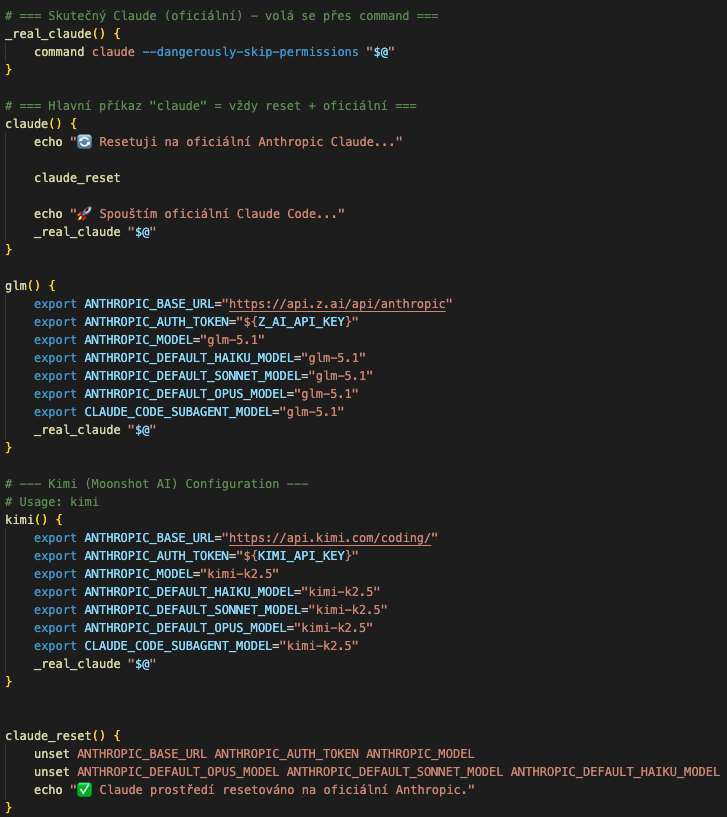
GLM-5.1 via Z.AI
Z.AI (智谱 AI) provides an Anthropic-compatible endpoint. Register at z.ai, grab your API key, then set these exact variables (from the Z.AI docs at docs.z.ai/devpack/tool/claude):
export ANTHROPIC_AUTH_TOKEN=<your-z.ai-api-key>
export ANTHROPIC_BASE_URL=https://api.z.ai/api/anthropic
export ANTHROPIC_DEFAULT_OPUS_MODEL="GLM-5.1"
export ANTHROPIC_DEFAULT_SONNET_MODEL="GLM-5.1"
export ANTHROPIC_DEFAULT_HAIKU_MODEL="GLM-4.5-Air"
export API_TIMEOUT_MS=3000000
Or run their one-liner setup script: curl -O "https://cdn.bigmodel.cn/install/claude_code_zai_env.sh" && bash ./claude_code_zai_env.sh — it writes these values into ~/.claude/settings.json automatically. Verify everything landed correctly with /status inside Claude Code.
Result: basic conversation and code reading worked well. Tool use was functional. The context window is generous and GLM-5.1 is noticeably more capable than earlier versions for multi-step reasoning tasks.
OpenRouter + Qwen 3 (6B)
OpenRouter acts as a unified gateway to hundreds of models. The configuration is slightly different — you need to explicitly blank out ANTHROPIC_API_KEY, otherwise Claude Code tries to use it instead of the OpenRouter key. From the OpenRouter docs (openrouter.ai/docs/guides/coding-agents/claude-code-integration):
export OPENROUTER_API_KEY="<your-openrouter-api-key>"
export ANTHROPIC_BASE_URL="https://openrouter.ai/api"
export ANTHROPIC_AUTH_TOKEN="$OPENROUTER_API_KEY"
export ANTHROPIC_API_KEY="" # Must be explicitly empty
export ANTHROPIC_DEFAULT_OPUS_MODEL="qwen/qwen3-6b"
export ANTHROPIC_DEFAULT_SONNET_MODEL="qwen/qwen3-6b"
export ANTHROPIC_DEFAULT_HAIKU_MODEL="qwen/qwen3-6b"
Alternatively, create .claude/settings.local.json in your project — this keeps provider config per-project without polluting your shell:
{
  "env": {
    "ANTHROPIC_BASE_URL": "https://openrouter.ai/api",
    "ANTHROPIC_AUTH_TOKEN": "<your-openrouter-api-key>",
    "ANTHROPIC_API_KEY": ""
  }
}
Important: don't use a regular .env file for these. Claude Code doesn't read standard .env files — use settings.local.json or export directly in your shell.
Result: Qwen 3.6 through OpenRouter was capable. Tool use worked via OpenRouter's protocol translation. Latency was reasonable. Cost-wise — significantly cheaper because free preview used.
Setup Openrouter for Claude Code
Kimi (Moonshot AI)
Moonshot AI's Kimi with up to 128k token context. OpenAI-compatible endpoint at api.moonshot.cn/v1. Basic conversation worked, tool use was unreliable. The long context is genuinely useful for reading large codebases, but without stable tool use it's limited.
Observations
What works regardless of provider: reading code, explaining logic, conversation. What depends on tool calling implementation: writing files, running shell commands, git operations — the core of what makes Claude Code an agent, not just a chat interface.
If a provider doesn't implement Anthropic's tool use format faithfully, you lose agentic capabilities. Z.AI and OpenRouter (with the right models) handle this best. Raw OpenAI-compatible endpoints without tool protocol support give you a smart assistant, not an autonomous coding agent.
Bottom line
Switching providers makes sense in two cases: you're testing how different models approach your specific codebase, or you need a cost-effective alternative for lighter tasks. For full agentic operation with tool use, Z.AI (GLM-5.1) and OpenRouter are the most reliable alternatives to native Anthropic right now. The LiteLLM proxy approach with OpenAI is close but requires extra infrastructure.
Run /status after setup to confirm Claude Code picked up the right model — saves debugging time when something silently falls back to defaults.